Loading
Gorilla trekkingRwanda + Uganda
Gorilla trekking permits, what they cost and how booking works
How much is a gorilla permit, and how do you get one?
The short answer
A gorilla permit costs USD 1,500 in Rwanda and USD 800 in Uganda, per person, for one trek. It buys 60 minutes with one habituated family, in a group of no more than eight trekkers, on a named date. Uganda also sells a habituation permit at USD 1,500 for four hours with a family in the Rushaga sector of Bwindi. Permits are limited by the number of habituated families, so the date is what you book first.
The numbers
- Rwanda permit
- USD 1,500
- Uganda permit
- USD 800
- Habituation, Rushaga
- USD 1,500, 4 hours
- Trekkers per family
- 8 per day
Last checked 17 October 2026. Permit prices are set by the national park authorities and are revised periodically.
Want this answered for your dates rather than in general?
What each permit costs
Primate permits in Rwanda and Uganda are issued per person, per trek, for one named date. They are the largest single line in the cost of a gorilla trip, and they are the reason the booking order runs permit first, lodge second.
| Permit | Where | Price | Time with the animals |
|---|---|---|---|
| Gorilla trek | Volcanoes National Park, Rwanda | USD 1,500 | 60 minutes |
| Gorilla trek | Bwindi Impenetrable Forest, Uganda | USD 800 | 60 minutes |
| Gorilla habituation | Rushaga sector, Bwindi | USD 1,500 | 4 hours |
| Chimpanzee trek | Kibale Forest, Uganda | USD 250 | 60 minutes |
| Chimpanzee trek | Nyungwe Forest, Rwanda | USD 100 | 60 minutes |
What the fee actually buys
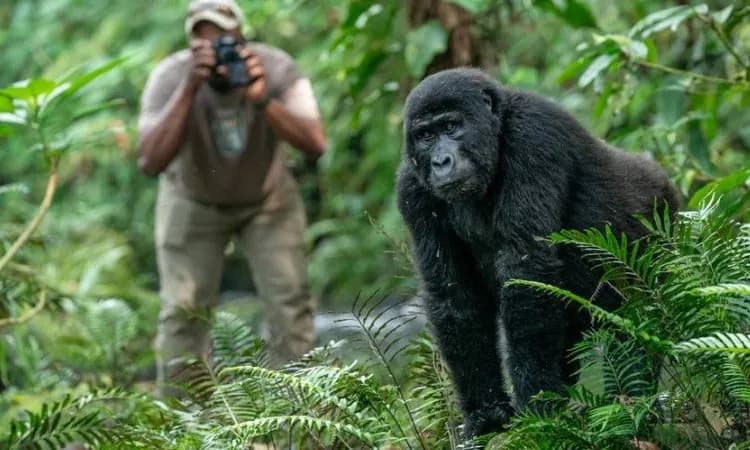
The permit covers the trek itself: your place in a group of no more than eight people with one gorilla family, and the ranger and tracker team who get you there. Trackers go out at first light and pick up the trail from the nests the family built the night before, then radio the position back. You walk to them.
The hour is a hard limit set by the park authority, not a guideline, and it starts when you reach the family. We plan the whole day around that hour rather than stacking anything behind it, because a trek can run one to five hours in Rwanda and one to six on the steeper Rushaga slopes before the hour even begins.
Park entry fees are separate from the permit. On our journeys both appear in what is included, so the figure you are quoted is the figure you pay.
Why permits sell out, and how early to book
Eight trekkers per family per day is a fixed ceiling, and the number of habituated families is small. Volcanoes National Park has twelve families on the Rwandan flank of the Virungas, which puts the whole park under a hundred permits a day. Bwindi is larger and holds around half the world's mountain gorillas across four trekking sectors, but the same eight-person cap applies to every family in it.
That ceiling collides with a short peak season. Rwanda treks best from June to September, Uganda from June to August, and the Ugandan window books out early. If your dates fall in either, treat the permit as the first thing you fix and everything else as flexible around it.
We hold your permit before invoicing the rest of the trip. A quote that does not say whether permits are held is a quote for a trip that may not exist on your dates.
The order to book in
Permits are issued by the Rwanda Development Board and by the Uganda Wildlife Authority, against a named person and a named date. We ask for passport details at the point we request one, which is why we need those earlier than most trip bookings require them.
In Bwindi the sector comes next, and it matters more than the lodge. The four sectors are hours apart by road, so we book the lodge against the sector the permit is for, never the other way round. Booking a lodge first and finding the permit is in another sector is the most common and most expensive mistake on a Uganda gorilla trip.
- Fix the dates, because the permit is dated and the dates are the scarce part
- Hold the permits, in Rwanda or in a named Bwindi sector
- Book the lodge against the sector, so the trailhead is a short drive
- Build the rest of the route around the trek morning
- Book international flights last, once the trek date is confirmed
Whether the permit is in the price you were quoted
Every journey we run that includes a trek lists the permit by name and price in what is included. On the three day Virunga Gorilla Express, from USD 2,180 per person sharing, the USD 1,500 Rwandan permit is inside that figure. On the six day Uganda route, from USD 2,890, the USD 800 Bwindi permit is inside it.
A second trek is not included anywhere, and it is the one add-on worth understanding before you decide. A second Rwandan permit is another USD 1,500. It buys a different family, usually a different trailhead and a different length of walk, which is the real argument for it: one trek is one family on one morning in one kind of weather.
Questions
- How much is a gorilla permit in Rwanda?
- USD 1,500 per person for one trek in Volcanoes National Park, which gives 60 minutes with one habituated family in a group of no more than eight trekkers.
- How much is a gorilla permit in Uganda?
- USD 800 per person for a standard trek in Bwindi Impenetrable Forest. Uganda also sells a habituation permit at USD 1,500, which gives four hours rather than one with a family in the Rushaga sector.
- How long do you get with the gorillas?
- Sixty minutes, capped by the park authority, with a maximum of eight trekkers per family per day. The walk to reach them runs one to five hours in Rwanda and one to six hours on the steeper slopes at Rushaga.
- How far in advance should I book a gorilla permit?
- As early as you can fix your dates, and earlier again for June to September in Rwanda or June to August in Uganda. Eight trekkers per family per day is a hard ceiling, and Volcanoes National Park has twelve habituated families in total.
- Can I buy a gorilla permit myself?
- The Rwanda Development Board and the Uganda Wildlife Authority issue them. We hold permits as part of a booking so that the permit, the sector and the lodge match, which in Bwindi is the difference between a short morning drive and a cross-country one.
- Is the permit included in your journey prices?
- Yes. Every journey with a trek lists the permit and its price in what is included, and we hold the permit before invoicing the rest of the trip. A second trek is listed separately, because the second permit is an extra USD 1,500 in Rwanda.
Where this applies
Read next
- Rwanda or Uganda for gorilla trekkingWhich country should I trek gorillas in?
- How hard is gorilla trekkingHow fit do I need to be to trek gorillas?
- What an East African safari costsHow much does a safari cost?
Ask us the part this did not answer.
A planner in Kigali reads it, not a form.