Loading
Timing and seasonsTanzania + Kenya
When to see the Great Migration
What is the best time to see the Great Migration?
The short answer
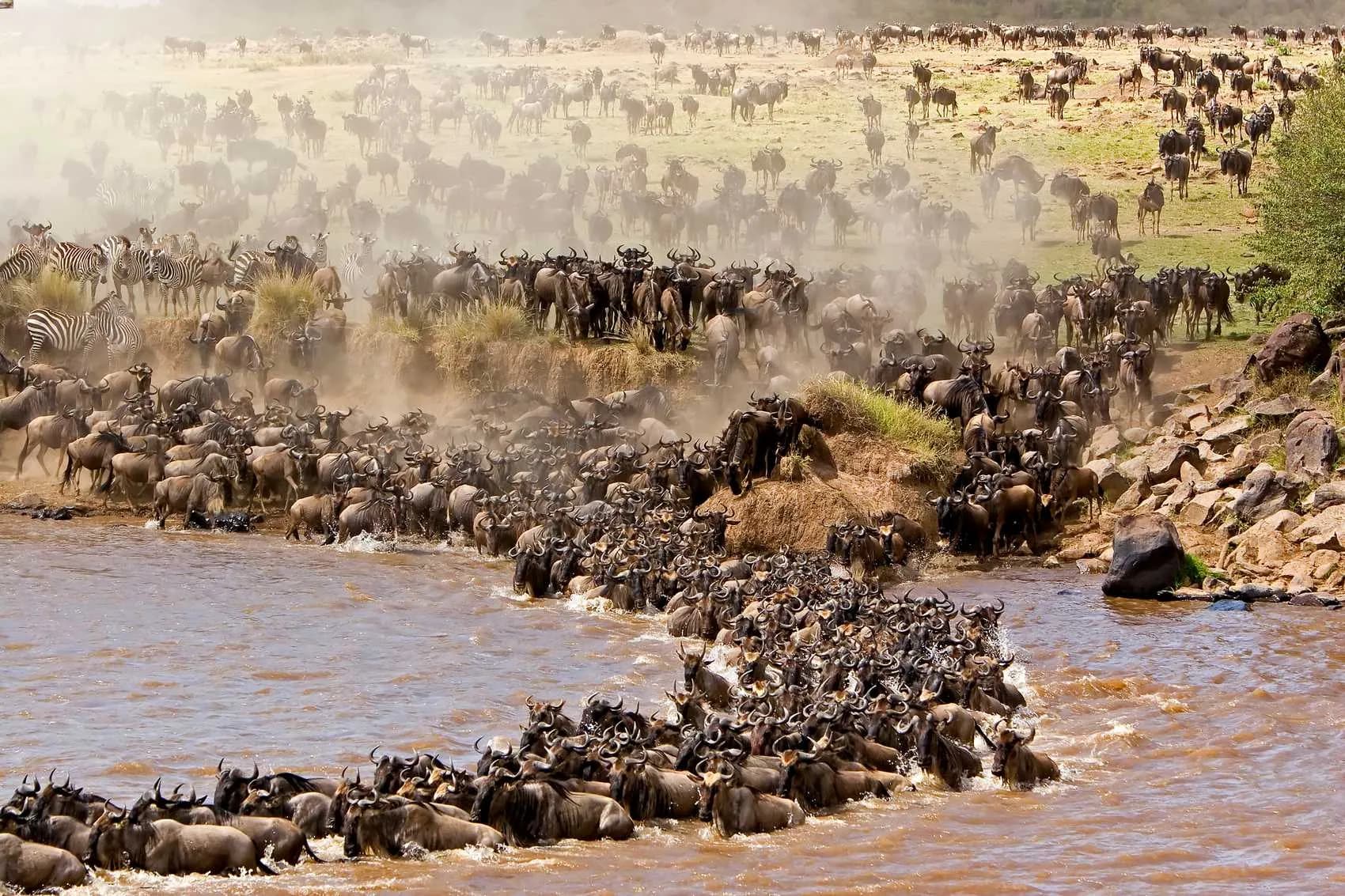
For the Mara River crossings, July to September in the northern Serengeti and July to October on the Kenyan side in the Maasai Mara. For the calving, February around Ndutu in the southern Serengeti, when predators are working the herds. About 1.5 million wildebeest circle the Serengeti and the Mara on a loop set by the rains, so the herds are somewhere in the ecosystem every month of the year, and the month decides which part of it you book.
The numbers
- River crossings
- Jul to Oct
- Calving
- Feb, Ndutu
- Herd size
- About 1.5 million wildebeest
- Suggested stay
- 4 to 5 nights with the herds
Last checked 17 October 2026. Permit prices are set by the national park authorities and are revised periodically.
Want this answered for your dates rather than in general?
Decide which event you came for
There is no single best month, because the migration is two very different spectacles at opposite ends of the year, and they happen in different places.
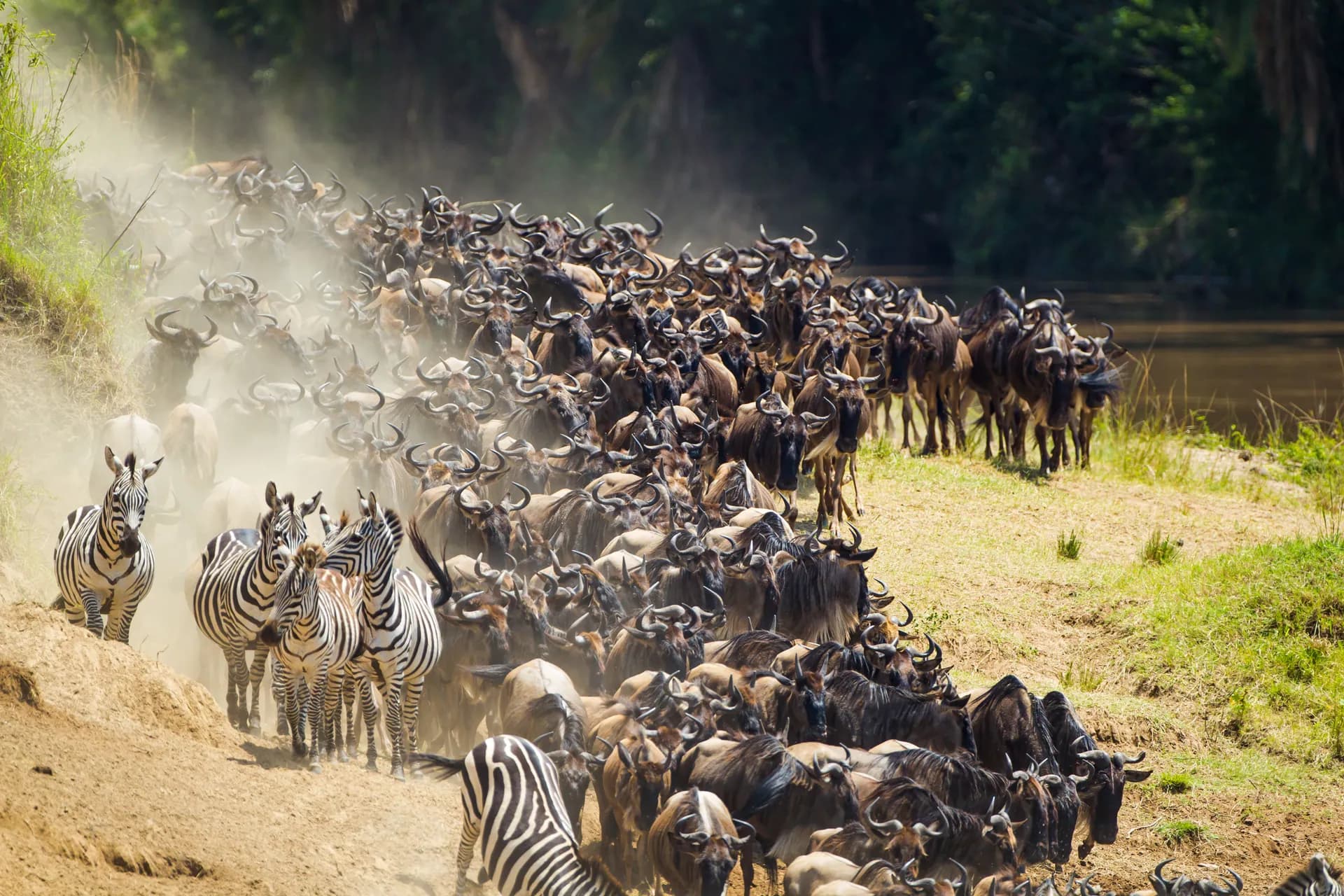
The river crossings are the headline. Herds pile up on the bank, hesitate, and then go, and that happens in the Kogatende area of the northern Serengeti from July to September and on the Kenyan side in the Maasai Mara from July to October. If this is what you pictured when you decided to come, your dates are already chosen for you.
Calving is the other one, and it is better than its reputation. In February the herds are concentrated around Ndutu in the southern Serengeti, dropping calves, and the predators that follow them are not subtle about it. It is a quieter month on the plains and the game viewing is dense rather than dramatic.
Where the herds are, month by month
The herds follow the rain, so this is a pattern rather than a timetable. Use it to choose a window, then let us place the camps once we know your dates.
| Months | Where the herds usually are | What that means |
|---|---|---|
| Jan to Mar | Southern Serengeti, around Ndutu | Calving in February, with predators on the herds |
| Apr to May | Southern and central plains | Long rains. Lowest rates, and some mobile camps move or close |
| Jun | Central plains, moving north | Dry season starting and the herds massing |
| Jul to Sep | Northern Serengeti, Kogatende | Mara River crossings on the Tanzanian side |
| Jul to Oct | Northern plains of the Maasai Mara | Crossings and the Kenyan side of the loop |
| Nov to Dec | South through the Seronera | Short rains and the herds strung out on the move |
Kenyan side or Tanzanian side
From July to October the herds are on both sides of the border, so this becomes a question about the rest of the trip rather than about the wildebeest.
The Maasai Mara carries the highest predator density in East Africa, and the private conservancies bordering the reserve cap the number of vehicles at a sighting and allow night drives and walking. It is also closer to its airport: 5.5 to 6 hours by road from Nairobi, or 45 minutes by air from Wilson. Our seven day Mara and Amboseli route starts at USD 3,640.
The Serengeti is the bigger landscape at thirty thousand square kilometres, and it holds the migration somewhere inside it every month, not only in the crossing season. It also pairs with the Ngorongoro Crater and with Zanzibar, which is why most of our Tanzanian itineraries end at the coast. Our eight day Great Migration Serengeti route starts at USD 5,420.
Nothing here runs to a schedule
The crossings are not a daily event at a fixed place. Herds can sit on a bank for two days and then cross three times in an afternoon. We place camps against where the herds are forecast for your dates, and in the crossing season that sometimes means a mobile camp rather than a lodge, because a lodge cannot move and the wildebeest can.
The practical consequence is time. Four to five nights with the herds is what we suggest, so that one quiet day is one quiet day rather than the whole trip. Two nights in the north in August is a gamble with a USD 5,000 trip.
August is also the month the best crossing camps fill first, so if that is your window, book it before you book anything else about the trip.
If your dates cannot move
Plenty of people can only travel in April, May or November, and the honest answer is that the migration will not be the centre of that trip. What replaces it is better than people expect.
The Ngorongoro Crater holds dense resident game on a 260 square kilometre floor and the best black rhino odds in the region, and it does not care what month it is. Tarangire has the densest dry season elephant population in northern Tanzania, strongest from June to October. The long rains, April and May in Tanzania and March to May in Kenya, bring the lowest rates of the year and the fewest vehicles, at the cost of some camps closing and harder going underfoot.
Questions
- What is the best month to see the Great Migration?
- August sits in the middle of the crossing season on both sides of the border, which makes it the single most reliable month for river crossings. It is also the month the best crossing camps fill first, so it needs the longest lead time.
- When are the Mara River crossings?
- July to September in the Kogatende area of the northern Serengeti, and July to October on the Kenyan side in the Maasai Mara.
- Can you guarantee I will see a river crossing?
- No, and nobody can. The herds follow the rain and can wait days on a bank before crossing. What we can do is place you with the herds for your dates, in a mobile camp if that is what the forecast calls for, and give the crossing four or five nights to happen rather than two.
- When is the calving season, and is it worth going for?
- February, around Ndutu in the southern Serengeti. The herds concentrate to drop calves and the predators follow them, so the game viewing is dense. It is quieter and usually cheaper than the crossing season.
- Kenya or Tanzania for the migration?
- Both hold the herds from July to October. Kenya is quicker to reach, has the highest predator density in East Africa and allows night drives and walking in the conservancies. Tanzania has the larger landscape, the herds year round, and pairs with Ngorongoro and Zanzibar.
- How many nights should I spend with the herds?
- Four to five. The crossings are not scheduled, so the extra nights are what turn a quiet day into one quiet day instead of a wasted trip.
Where this applies
Read next
- Maasai Mara or SerengetiShould I go to the Maasai Mara or the Serengeti?
- Planning a first safari in East AfricaHow do I plan a first safari?
- What an East African safari costsHow much does a safari cost?
Ask us the part this did not answer.
A planner in Kigali reads it, not a form.